Online shopping has revolutionized the way we shop for our desired products. It has become quicker, more efficient, and more convenient than ever before. With just a few mouse clicks, we can compare prices, apply coupons, and receive our ordered products at our doorsteps. However, there is something that many online shoppers are unaware of: the final price of the ordered items is higher than the initial price.
There are many hidden costs behind the discounts and deals that many online shopping websites offer to their customers. These costs may not be clearly visible to the customers; however, being aware of these hidden costs can make you a smart buyer.
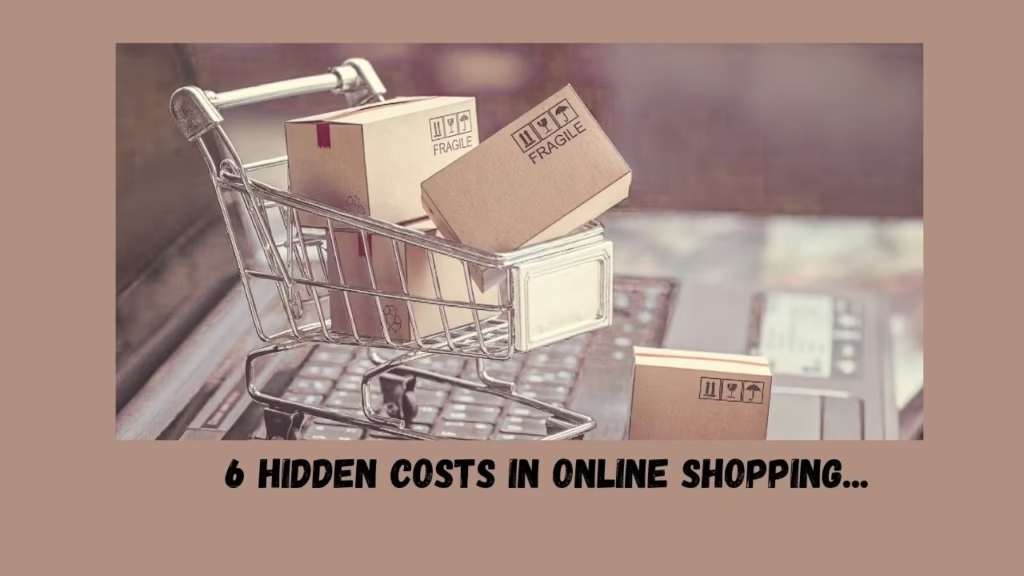
In this article, we will discuss the 6 most common hidden costs in online shopping.
Delivery Charges & Convenience Fees
One of the most common hidden charges faced by consumers is the delivery charge. This charge usually appears at the time of payment.
Key points:
- Free delivery is only applicable on orders above a specific amount.
- “Convenience fees” may also be applicable in cases where free delivery is offered.
Many online platforms display “FREE DELIVERY” on their websites. However, this is applicable only when the amount in the shopping cart is greater than a specific amount. Additionally, a small convenience fee is charged by the platform in cases of high demand.
Thus, the final price may vary even when discounts are applied.
Platform Fees & Handling Charges
Another hidden cost faced by consumers is the platform fee. This charge is becoming increasingly common.
Key points:
- Charged as a “handling fee” at the time of payment.
- Common in food delivery and quick commerce platforms.
This charge is small on a per-order basis. However, when considered over time, this charge causes a significant increase in the total amount spent by consumers. This charge is usually levied at the final stage. Hence, the consumers don’t get to know about it when the prices are compared.
Payment Method Charges & Bank Conditions
Not all payment methods are the same. Some may have hidden fees or savings that are not being utilized.
If a customer selects a payment method like Cash on Delivery, there may be an extra charge. Also, there may be discounts that are only available if the customer uses a specific bank’s cards. If they do not use those cards, they end up paying more compared to other customers.
In some cases, EMI may be available for “no extra cost.” This may not be true because there may be extra processing fees or slightly higher prices for the products.
Price Inflation Before Discounts
The biggest hidden cost that customers are not aware of is price inflation.
Sellers may inflate the price of the product before offering a discount. This means that before applying a discount, the base price of the product may be artificially inflated. For example, a product that originally costs ₹1,000 may be priced at ₹1,499 with a “33% OFF” tag. This means that the price of the product has not actually decreased.
Return, Replacement & Reverse Pickup Costs
In some cases, returns may not entirely be free.
While some platforms may offer free returns on their platform.
In other cases like:
- Deduction of shipping charges may apply.
- In some cases, restocking charges may apply.
- Delivery charges may not be refunded.
In addition to this, in some cases, especially during sales events, the rules on returns may become more stringent. Some products may carry a label such as ‘Non-Returnable’ or ‘Replacement Only,’ which may result in loss in case the product does not meet expectations.
Subscription & Membership Costs
Many platforms also offer ‘membership’ options that promise ‘extra savings,’ which come at a cost.
Services such as premium memberships may carry benefits.
Such as:
- Free delivery.
- Early access to sales.
- Exclusive discounts.
However, in addition to these benefits, there is also an upfront cost to pay. This cost may exceed the benefits in cases when one does not end up shopping on these platforms very often.
Hidden Costs of Online Shopping – Quick Overview Table
| Hidden Cost Types | Where It will Appear | Impact on Buyers |
|---|---|---|
| Delivery Charges | Checkout stage | Increases final bill |
| Platform/Handling Fee | Final payment page | Small but recurring cost |
| Payment Method Charges | During payment selection | Loss of discounts or extra fee |
| Price Inflation | Product listing page | Misleading discount perception |
| Return/Refund Costs | After purchase | Reduced refund value |
| Subscription Fees | Membership plans | Additional long-term expense |
Why These Hidden Costs Exist
The platforms have a complicated business model that involves several expenses such as logistical, marketing, commission, and payment processing fees. To remain profitable while still offering discounts to buyers, they have to spread out these expenses over various stages of the buyer’s experience.
Rather than increasing the price of the products, the platforms impose various hidden costs that are lower and less noticeable. This allows them to remain competitive while still covering their expenses.
How Hidden Costs Influence Your Shopping Choices
Hidden costs play an important role in determining how much you are ultimately saving. A discount may initially appear to be a good bargain, but ultimately, you may find that you are paying an average or higher price for a product because you have to pay extra for various hidden costs.
For example, you may find a product that is available for ₹999. After adding various hidden costs, you may find that you are ultimately paying ₹1,150. Therefore, you need to know and be aware of this kinds of situation to avoid the unnecessary expenses while shopping. This is especially true during big sales.
Smart Ways to Avoid Hidden Costs
To be a smarter shopper, you need to be aware of not only various discounts but also the final amount you are paying.
Some steps that you need to take are as follows:
- Always check the final amount you are paying before you make any payments.
- Try to compare prices on various platforms.
- Always try to read the return policies.
- Try to avoid unnecessary subscriptions.
- Try to choose your payment methods correctly.
Final Thoughts
While it’s true that online shopping can be a convenient and even cost-effective experience, it’s only true if one shops carefully. The fact of the matter is that there are hidden costs built into the system, and if one isn’t paying close attention to their spending, it’s easy to see how these hidden costs could add up.
While it’s true that understanding the hidden costs of online shopping can help one save money, it’s also true that it can help one shop more clearly. Rather than focusing solely on the savings that one can reap, smart shoppers are focused on the overall value that they’re receiving.
In other words, The best deal isn’t the one with the biggest discount—it’s the one with the lowest final cost.
For More Information You Can Visit our Page
Frequently Asked Questions (FAQs)
What are hidden costs in online shopping?
Hidden costs are extra costs charged while shopping online, which can be shipping charges, online platform charges, or payment charges.
Why does the final price will increase at final checkout?
The final price increases because extra charges are added in the last step while shopping online.
Are “free delivery” offers always truly free?
No. “Free Delivery” is not always free.
Do payment methods affect the final price?
Yes. The payment methods also affect the final price because some payment methods charge extra or skip bank discounts.
Why do discounts sometimes feel misleading?
Discounts can sometimes feel misleading because the initial price charged is more to give a discount later.